News / field report
Benchmarking Sonnet 5.5: less thinking for the same answers
Measured on our 48-task suite, not on your traffic. At the same effort level, Sonnet 5.5 solved at least as many tasks and usually spent less.
- Author
- Julius Brussee
- Published
- 28 September 2026
- Length
- 7 min read
We ran Claude Sonnet 5.5 and Sonnet 5 through the same 48 tasks at every effort level, with Opus 5.5, Sonnet 4.6 and Haiku 4.5 as reference points. Code graded every task. That came to 3,268 runs and 5,906 API requests, for $198.35 at list prices.
At the same effort level, Sonnet 5.5 solved at least as many tasks and usually
spent less. How much less depends on the task. On long reasoning problems, where
Sonnet 5 thinks for a long time, Sonnet 5.5 used a fraction of the tokens. On a
typical task at high it used about half the output tokens. On chat, extraction
and long-document work the two cost about the same.
What we ran
48 tasks in eight kinds: short chat questions (3), JSON extraction (3), an executive summary with a word limit (1), exact-answer reasoning problems whose answers we computed by brute force (21), code generation checked by hidden tests (10), a question about a 70k-token production log (1), agents that fix small Python repositories and are graded by hidden tests after the loop ends (6), and agents that answer questions from an internal wiki (3). No model graded another model. We checked every grader against a reference solution, which must pass, and against the untouched starting state, which must fail.
The suite leans on reasoning: 21 of 48 tasks, and 66% of Sonnet 5's cost at
high. Keep that in mind when you read the suite-wide numbers below. We also
give the median task, which is less sensitive to the mix.
Sonnet 5.5 and Sonnet 5 ran at off, low, medium, high, xhigh and max: five reps
per task, except three at max on the 11 hardest tasks. "Off" means
thinking: between_tools on Sonnet 5.5 and disabled on Sonnet 5. The
reference models ran three reps.
Same effort, less output
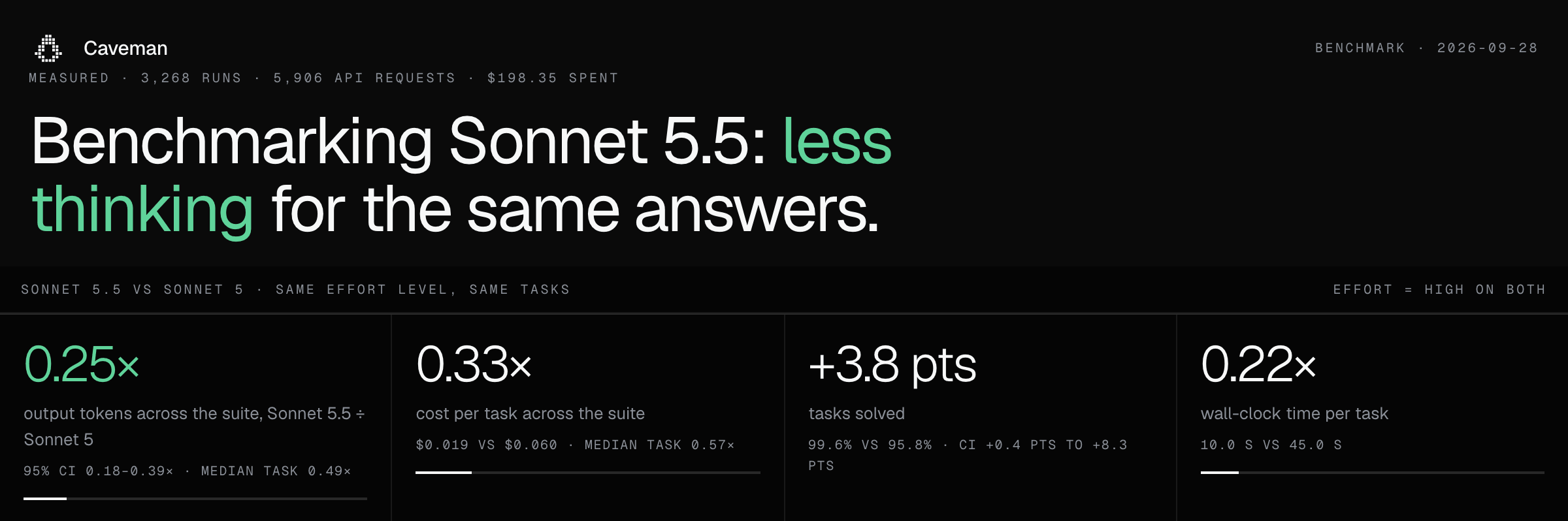
With both models at high, the default effort on both:
| Sonnet 5.5 | Sonnet 5 | Suite ratio | Median task | |
|---|---|---|---|---|
| Output tokens per task | 1,317 | 5,237 | 0.25× (95% CI 0.18–0.39) | 0.49× |
| Cost per task | $0.0195 | $0.0597 | 0.33× | 0.57× |
| Tasks solved | 99.6% | 95.8% | +3.8 pts (CI +0.4 to +8.3) | |
| Wall time per task | 10.0 s | 45.0 s | 0.22× |
37 of the 48 tasks were cheaper on Sonnet 5.5. The suite ratio comes out lower than the median because five long reasoning problems account for most of Sonnet 5's output. Leaving out the reasoning tasks altogether, Sonnet 5.5 produced 0.56× the output tokens.
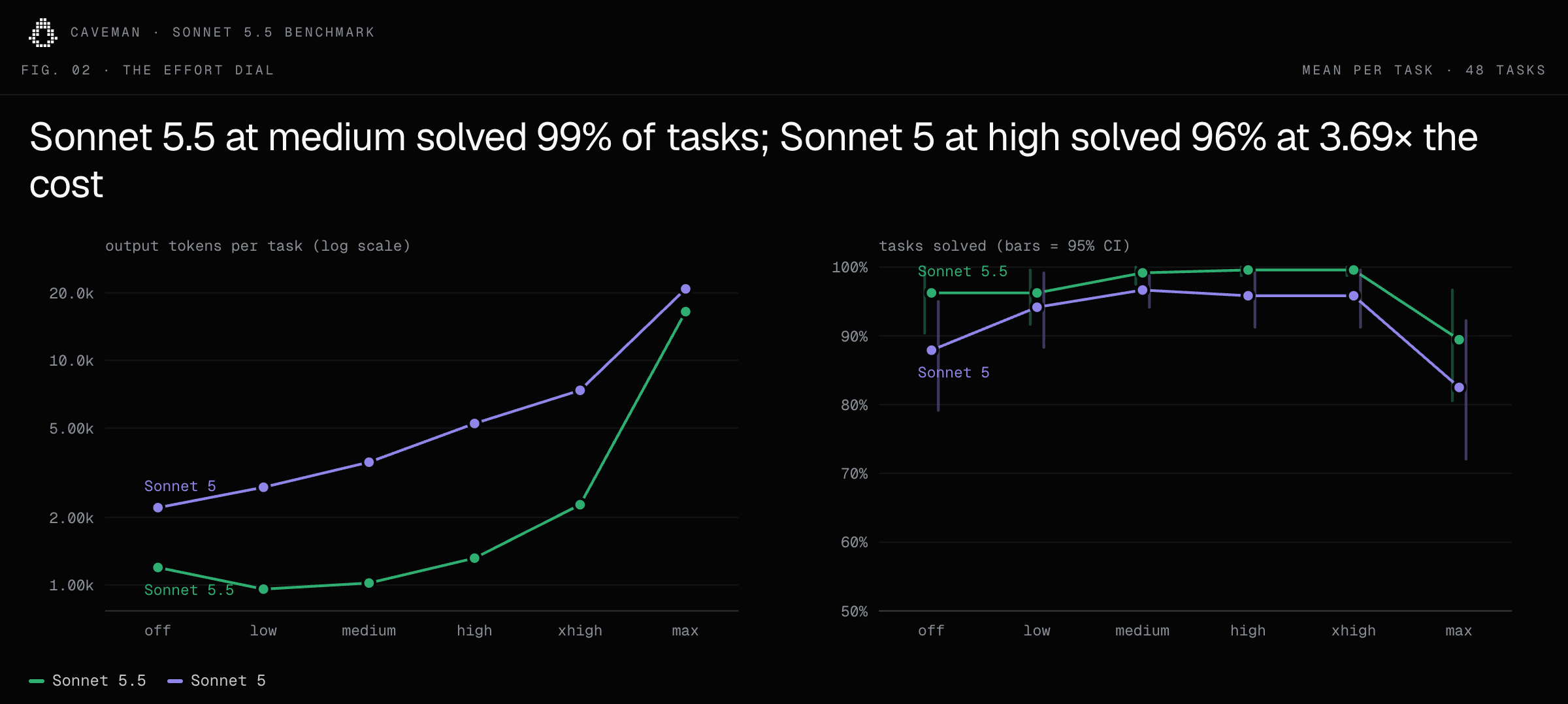
The gap grows with effort. At low there's no saving on a typical task (median
1.19× the output tokens, 0.99× the cost), and only the hard reasoning problems
come out cheaper. From medium up, most tasks get cheaper.
Laid end to end, taking one median-cost run per task, the whole suite at high
took Sonnet 5.5 490 seconds and 63k output tokens. Sonnet 5 needed 2,034 seconds
and 232k. In the runs shown, both solved all 48.
The effort dial moved
Sonnet 5.5 at high produced fewer output tokens than Sonnet 5 at low (1,317
against 2,724 per task). A setting copied over from Sonnet 5 buys something
different now.
The pairing we would start from: Sonnet 5 at high → Sonnet 5.5 at medium. On this suite, tasks solved went from 95.8% to 99.2%. Cost fell to 0.41× on the median task and 0.27× across the suite, and 41 of 48 tasks came out cheaper.
On single requests, the difference is thinking
On single-request tasks, the gap is hidden thinking. At medium, 83% of
Sonnet 5's output tokens were thinking, against 37% on Sonnet 5.5. At high it
was 85% against 47%. We estimate this by subtracting a count_tokens count of
the visible text and tool calls from the billed output tokens. The same probe
gives 1% for Sonnet 5 with thinking disabled, as it should.
Agents are different. There, output per task was about the same (0.98× on coding
agents, 1.15× on research agents at medium), and the saving came from fewer
turns (Agents take fewer turns).
Where the bill moves, and where it doesn't
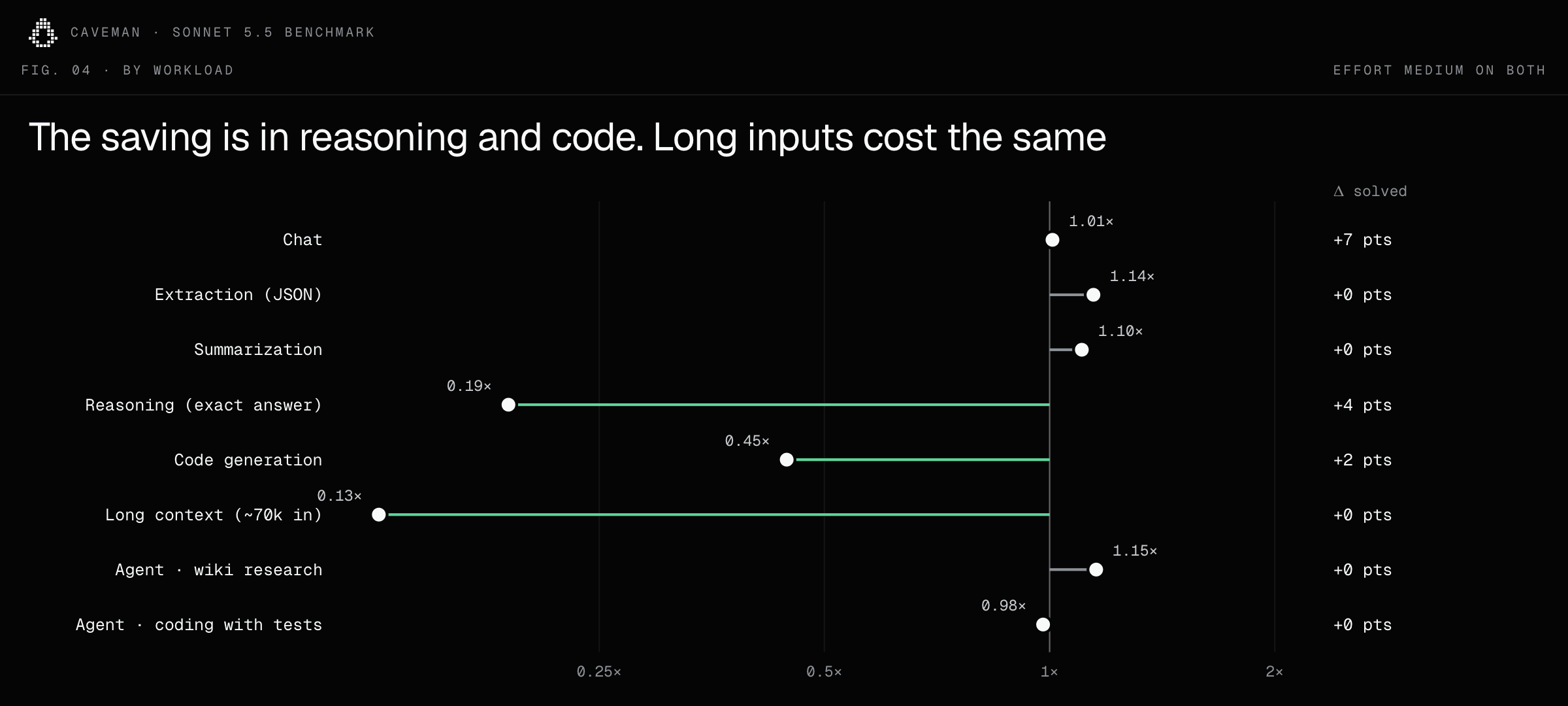
Sonnet 5.5 output tokens as a multiple of Sonnet 5 at medium:
- Exact-answer reasoning (21 tasks): 0.19×
- Code generation (10 tasks): 0.45×
- Chat, extraction, summary (7 tasks): 1.01–1.14×
- The 70k-token log question (1 task): output 0.13×, but cost 0.99×, because input dominates and input tokens cost the same on both models
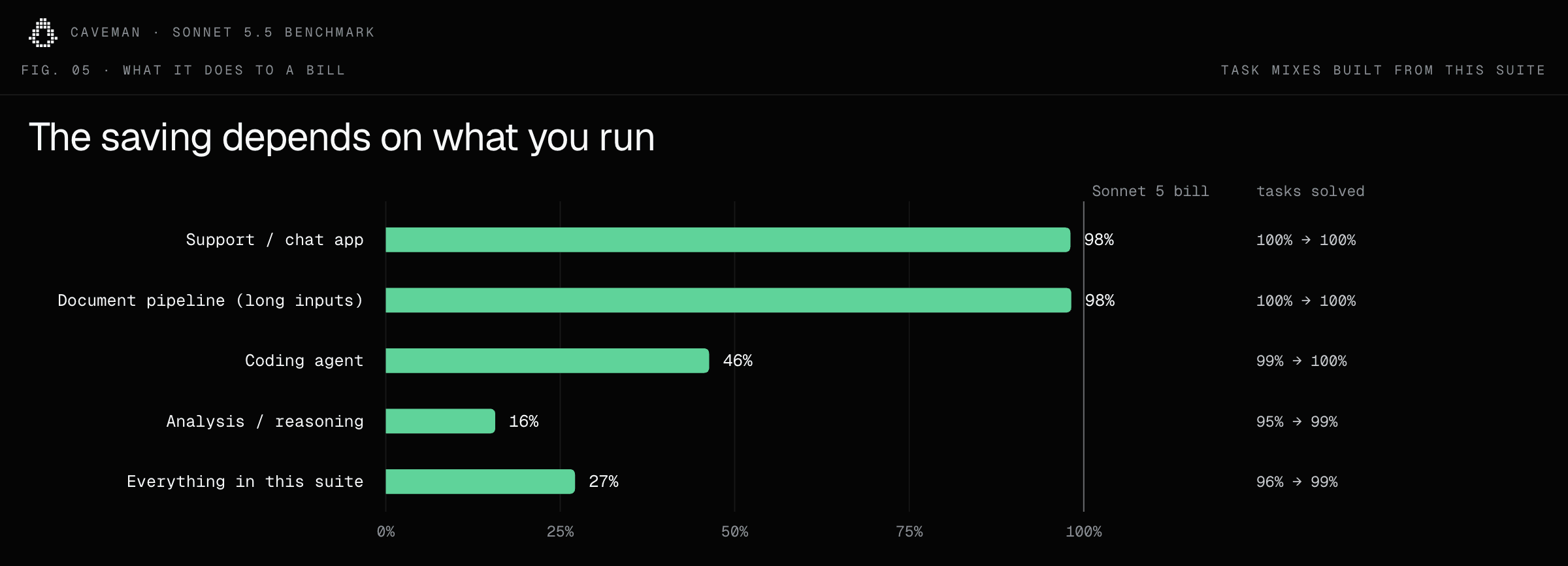
So the saving depends on the mix. Taking this suite's per-category results for the switch from Sonnet 5 at high to Sonnet 5.5 at medium:
| Mix | Cost vs Sonnet 5 |
|---|---|
| Support / chat app | 98% |
| Document pipeline (long inputs) | 98% |
| Coding agent | 46% |
| Analysis / reasoning | 16% |
| All 48 tasks | 27% |
These mixes are weighted averages of our tasks, not a forecast, and some categories rest on one to three tasks. Caveman shows the real mix of your own traffic by workflow, and that's the number to use.
Agents take fewer turns
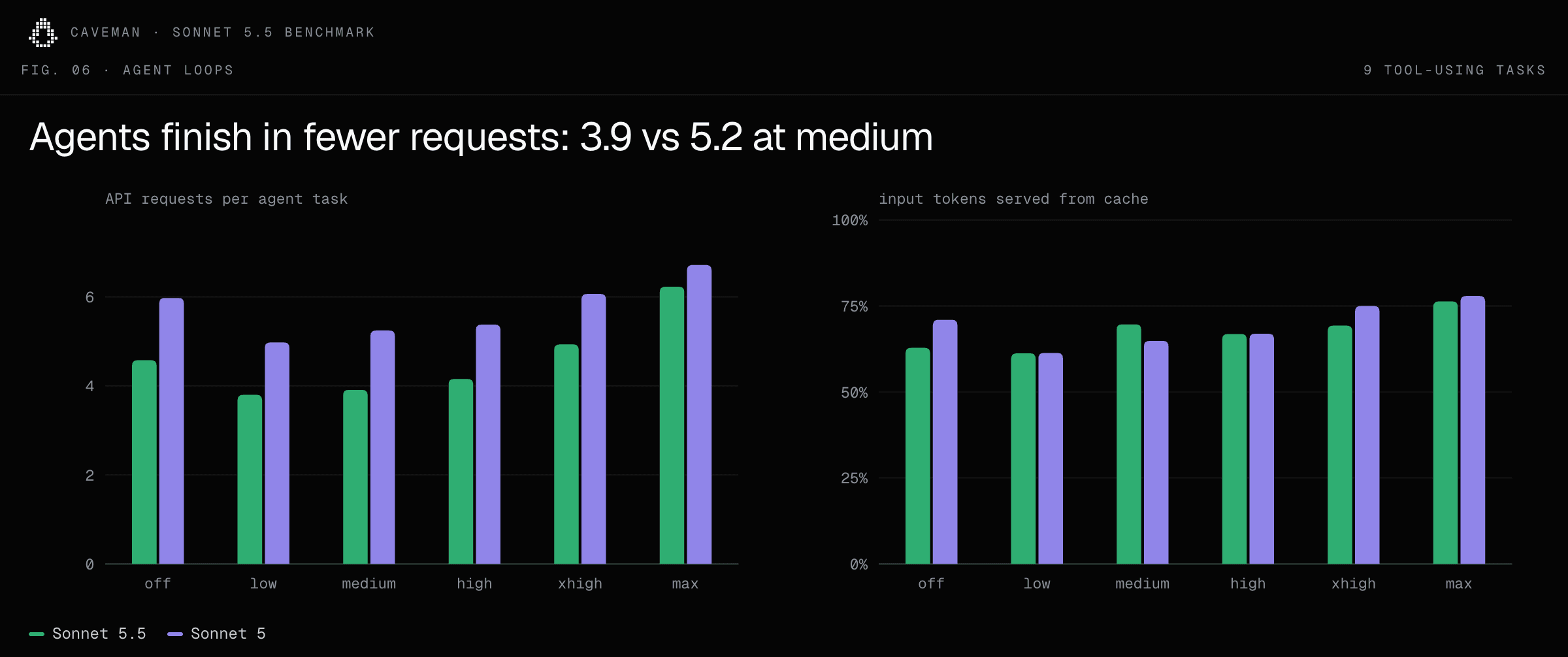
On the nine tool-using tasks, Sonnet 5.5 at medium finished in 3.9 API requests on average, against 5.2 for Sonnet 5. Agent cost per task was 0.77×. Every agent turn re-sends the conversation, so fewer turns cut input spend even when output stays flat.
Small prompts also start caching sooner. Sonnet 5.5's minimum cacheable prompt is 512 tokens; Sonnet 5's is 1,024. Our pricing-bug agent starts with a system prompt and tool list of about 760 tokens. On Sonnet 5 the first two turns sat below the minimum and billed 1,708 uncached input tokens before caching took over. On Sonnet 5.5, caching applied from the first turn, and each run billed 12 or fewer uncached input tokens.
Waiting
Median time to the first visible token across single-request runs was 0.85 s for
Sonnet 5.5 at medium and 2.9 s for Sonnet 5 at medium. At high it was 2.4 s
against 6.3 s. Wall time and time to first token were measured on the client
with 8 to 24 requests in flight, so both include queueing.
Leave max off
max cost 6× as much as xhigh on Sonnet 5.5 and solved fewer tasks (89%
against 99.6%). Every max failure was a long answer hitting our 64k output cap,
on both models. On this suite, xhigh was the top of the useful range, and medium
or high covered almost everything.
The reference models
- Opus 5.5 at medium solved 98.6% at $0.042 per task, 2.1× the cost of Sonnet 5.5 at high. Our tasks don't include the long, hard work where Opus should earn its price, so read this as "not needed here", not as a verdict on Opus.
- Haiku 4.5 is the cheapest per task ($0.011) but solved 60%, which works out to $0.0176 per solved task. Sonnet 5.5 at low came to $0.0164 per solved task at 96%.
- Sonnet 4.6 at high solved 91.7% at $0.199 per task, 12× Sonnet 5.5 at medium.
- Thinking off is not quite like for like. Sonnet 5.5 with
between_toolssolved 96.2% and Sonnet 5 with thinking disabled solved 87.9%, butbetween_toolsstill returns short progress notes as thinking blocks (about a quarter of its output), where Sonnet 5 returns none.
One trap when comparing across generations: Sonnet 5, Sonnet 5.5 and Opus 5.5 share a tokenizer that counts 1.40× more tokens than Sonnet 4.6 on the same English text (1.15× on code, 1.23× on logs). Per-million-token prices don't compare directly.
What to do
- Move Sonnet 5 at high to Sonnet 5.5 at medium, and compare the two on your own traffic before you change the default.
- Set effort explicitly. The levels were recalibrated, so a Sonnet 5 setting
carried over lands somewhere else. At
low, don't expect a saving on typical tasks. - Don't expect a change on long-input work. Caching and trimming inputs matter more there than the model switch.
- Leave max off. If you use xhigh, give it a large
max_tokens. - Keep agent histories append-only. Sonnet 5.5 binds thinking blocks to the conversation. Editing earlier turns throws that reasoning away, and on accounts created since 31 August 2026 it returns an error.
Limits
These are our 48 tasks, not your traffic, and they lean on reasoning. The coding
and agent tasks were small enough that almost every configuration solved them,
so they show cost differences better than quality differences. The gains in
tasks solved at medium, high and xhigh are small; their confidence intervals
exclude zero, while the one at low does not. max was capped at 64k output
tokens. No refusals occurred. Eleven runs failed with API overload errors; we
retried them, and they don't count against either model. These are measured
benchmark numbers, and they only become savings on your account when your own
traffic shows them.
Replies go to contact@caveman.ac
All news